
1. The Crisis of Trust and the Rise of the “System”
The reflections below were shaped after listening to a recent discussion hosted by the Independent Medical Alliance (IMA):
https://www.youtube.com/watch?v=e_3L6AYgMZQ
But what stood out wasn’t just what was said—it was how closely it reflects what many of us have already seen from the inside.
Modern healthcare isn’t just under pressure—it’s operating inside a system that often feels disconnected from its original purpose. What was once a patient-centered profession has, in many environments, become a system-centered operation.
From my perspective—having worked in IT across healthcare environments, helped stand up medical practices, and operated businesses within the space—the tension is real:
- Policies often outweigh judgment
- Risk mitigation outweighs outcomes
- Systems protect themselves before they protect patients
At some point, this stops being inefficiency—and starts becoming a trust problem.
And when trust breaks down, everything else follows.
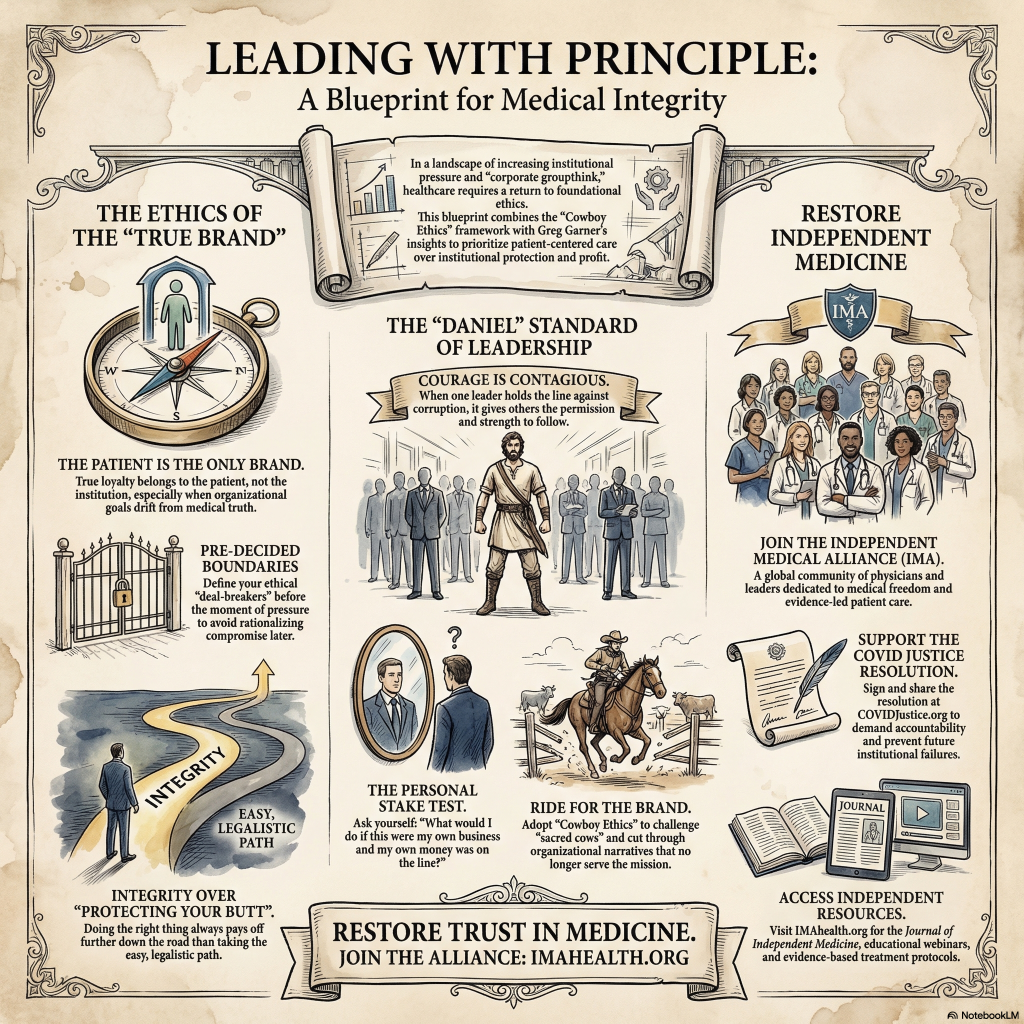
2. Ride for the Brand: Remembering Who the “Brand” Actually Is
In traditional “Code of the West” thinking, riding for the brand meant loyalty to the mission.
In modern healthcare, that concept has been distorted.
Today, “the brand” is often interpreted as:
- The hospital system
- The organization
- The legal structure
- The billing engine
But that’s not the real brand.
The real brand is the patient.
Chris Ekrem shared a powerful framing that cuts through the noise:
Strip away the system and ask — what would I do if this were my own business, my own money, and my own responsibility?
That question exposes the gap between:
- What we’re told to do
- And what we know is right
Because at the end of the day, no one gets into healthcare to serve a system.
They get into it to serve people.
3. The Kool-Aid Problem (And Why You Can’t Drink It All)
One of the more practical—and honest—takeaways came from a metaphor discussed in the conversation.
Greg Garner referenced the idea of being handed a “glass of Kool-Aid” inside organizations—though the underlying concept originated from Chris Ekrem.
The idea is simple:
You may need to take a sip to function within a system.
But you should never drink the whole glass.
Because when you do:
- You lose objectivity
- You stop questioning
- You begin defending things you once would have challenged
The healthiest professionals—the ones who maintain integrity—do something different:
They step back.
They observe.
They keep perspective.
Not rebellious. Not disengaged.
Just awake.
4. “Cover Your Saddle” vs. Doing What’s Right
One of the quiet but powerful realities in healthcare is this:
Many decisions are not driven by what’s best…
They’re driven by what’s safest—for the organization.
In other words:
👉 “Cover your saddle”
That shows up as:
- Defensive medicine
- Over-documentation
- Coding decisions influenced by reimbursement
- Policies designed to reduce liability, not improve outcomes
And to be clear—some level of protection is necessary.
But when “cover your saddle” becomes the primary driver, the system begins to drift.
Because now the question is no longer:
“What’s right?”
It becomes:
“What’s defensible?”
And those are not always the same thing.
5. The Courage Gap — and Why It Matters
The podcast didn’t just highlight problems—it highlighted something more important:
👉 The lack of aligned courage
Not because people don’t care.
But because:
- The system is large
- The incentives are real
- The consequences are tangible
Standing firm has a cost.
Professionally. Socially. Financially.
But there’s also a hidden truth:
Courage compounds.
When one person:
- Speaks up
- Questions appropriately
- Refuses to blindly comply
It gives others permission to do the same.
And that’s how change actually starts.
Not from the top.
But from individuals who decide where their line is.
6. Breaking the “Sacred Cows”
Another recurring theme:
There are ideas, protocols, and structures in healthcare that no one questions anymore.
They’ve become “sacred cows.”
But as the saying goes:
Sacred cows make the best burgers.
Not everything that exists should continue to exist.
Especially when:
- It no longer serves patients
- It’s driven by outdated assumptions
- Or it persists because it’s profitable, not effective
Progress requires:
- Re-examining assumptions
- Challenging incentives
- And being willing to rethink what’s been normalized
7. The Parallel Path Forward
If trust is going to be rebuilt, it likely won’t come from the same structures that lost it.
It will come from parallel systems:
- Independent thinking
- Transparent data
- Decentralized models
- Professionals willing to operate with integrity, even inside imperfect systems
Trust isn’t demanded.
It’s earned over time:
- Through consistency
- Through results
- Through alignment between words and actions
7. Conclusion: The Parallel Path Forward
This isn’t about tearing down healthcare.
It’s about realigning it.
If enough people begin to:
- Ride for the right brand
- Maintain perspective
- Resist blind conformity
- And act with measured courage
Then the system doesn’t have to be overthrown.
It evolves.
If even a small percentage of professionals draw that line…
The impact would be bigger than most people realize.
Restoring trust in healthcare will not happen through the same captured institutions that broke it. We must build “parallel systems”—structures like the Journal of Independent Medicine—that bypass the influence of Big Pharma and corporate gatekeepers.
Real trust is not “blind”; it is an evidence-based conclusion drawn over a long period of consistent ethical action. When a new leader steps into a room and says, “Just trust me,” it is an immediate “red flag.” Trust is earned through data and integrity, not demanded via title. As we look toward the future, we must move past the “Trust me, bro” era of public health and return to the hard, principled work of the Code of the West.
If 10,000 “Daniels” stepped forward in your field today, what would the world look like tomorrow? The answer is a world where medicine is once again a noble calling, and the patient is the only brand that matters.