

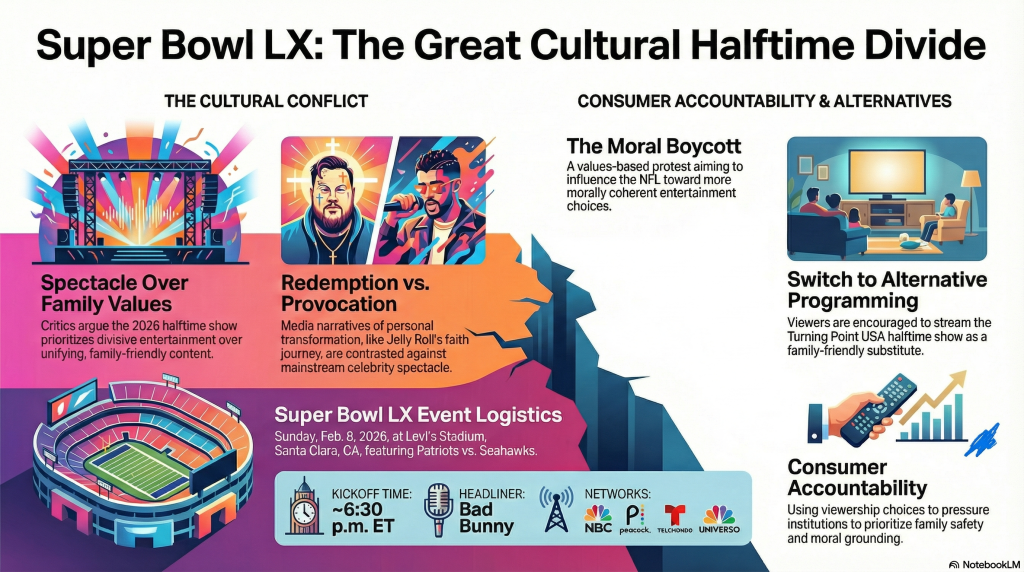
Super Bowl LX will air on Sunday, February 8, 2026, with kickoff scheduled for approximately 6:30 p.m. Eastern Time.
Super Bowl LX will air on Sunday, February 8, 2026, with kickoff scheduled for approximately 6:30 p.m. Eastern Time.
For decades, the Super Bowl halftime show has served as a shared cultural moment meant to unite families across generations. This year, however, the selection of Bad Bunny as the halftime headliner has triggered a deeper conversation about cultural alignment, moral coherence, and the direction of America’s most influential sports institution.
Super Bowl LX will air on Sunday, February 8, 2026, with kickoff scheduled for approximately 6:30 p.m. Eastern Time.
For decades, the Super Bowl halftime show has served as a shared cultural moment meant to unite families across generations. This year, however, the selection of Bad Bunny as the halftime headliner has triggered a deeper conversation about cultural alignment, moral coherence, and the direction of America’s most influential sports institution.
A Cultural Moment That Reveals a Deeper Divide
For decades, the Super Bowl halftime show has functioned as a shared cultural moment—one of the few remaining events where families across generations gathered around the same screen. It wasn’t perfect, but it was broadly unifying.
That assumption no longer holds.
Super Bowl LX represents something different. The controversy surrounding the selection of Bad Bunny as the halftime headliner is not simply about musical taste. It’s about cultural alignment, moral coherence, and whether one of America’s most influential institutions still understands the audience it claims to serve.
When an event marketed as family entertainment repeatedly delivers performances that many families feel they must shield their children from, something has gone wrong.
This isn’t about censorship. It’s about accountability.
Spectacle vs. Meaning
Modern halftime shows increasingly rely on provocation, shock, and spectacle rather than substance. Sexualized imagery, political signaling, and aesthetic excess have replaced performances that once aimed—at minimum—to be broadly accessible.
At the same time, we’re told that objections are merely subjective, that “art is in the eye of the beholder,” and that intention doesn’t matter.
But intention always matters.
Music, art, and performance are not neutral. They shape culture, reinforce values, and communicate meaning—sometimes more powerfully than words alone.
This is why the contrast raised in The World and Everything In It podcast episode (February 6, 2026) is so striking.
Redemption as a Competing Story
In the same cultural moment that the NFL elevates spectacle, another story has been quietly resonating: redemption.
During their discussion—framed partly around the Grammys and partly around the Super Bowl—hosts highlighted the testimony of Jelly Roll, an artist whose public narrative centers not on provocation, but on transformation.
His story includes addiction, incarceration, failure, faith, and recovery. Whether one shares his beliefs or not, the arc is unmistakably human—and deeply compelling.
Redemption stories endure because they reflect something true about the human condition: people can change, and meaning matters more than image.
That contrast—redemption versus provocation—is at the heart of this cultural divide.
The Case for a Moral Boycott
A boycott is not silence. It is speech.
Choosing not to participate in the official halftime broadcast is a way of saying: this no longer represents us.
Super Bowl LX will air on Sunday, February 8, 2026, with kickoff scheduled for approximately 6:30 p.m. Eastern Time. Viewers can still enjoy the game itself while opting out of the halftime programming.
That choice matters.
Ratings drive decisions. Attention is currency. When enough people withhold it, institutions are forced to listen.
A Constructive Alternative
Importantly, this is not merely a protest—it’s a redirection.
Turning Point USA has organized an alternative, family-friendly halftime program designed to offer high-energy entertainment without sexual exploitation or overt political messaging. The stream will be available during halftime on Sunday, February 8, 2026, and can be accessed directly at:
The goal isn’t to replace one celebrity culture with another. It’s to demonstrate that audiences still value taste, restraint, and coherence—and that those values can succeed when given support.
Consumer Accountability Still Works
Large institutions rarely change because of internal reflection. They change when external pressure becomes unavoidable.
The NFL responds to numbers. Advertisers respond to viewership. Cultural signals travel upstream.
Choosing what not to watch is as powerful as choosing what to support.
This moment is an invitation—not just to critique, but to act deliberately.
How This Was Built
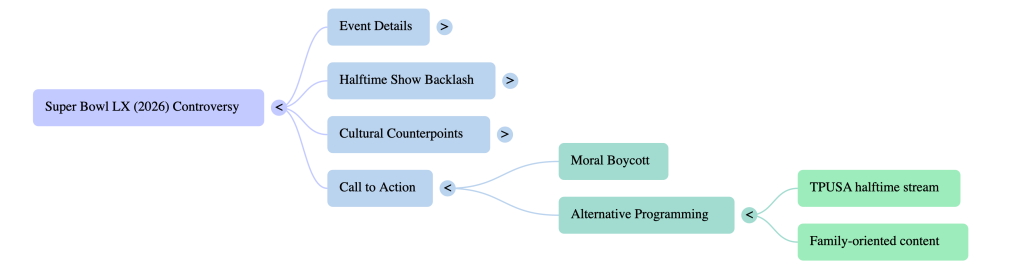
These materials are included for readers who want to see the full reasoning, structure, and source synthesis behind the episode.
Closing Thought
Culture doesn’t shift because elites decree it. It shifts when ordinary people decide what they will—and will not—normalize.
Super Bowl LX is just one event. But it reveals a larger truth: we still have agency, and how we use it shapes what comes next.