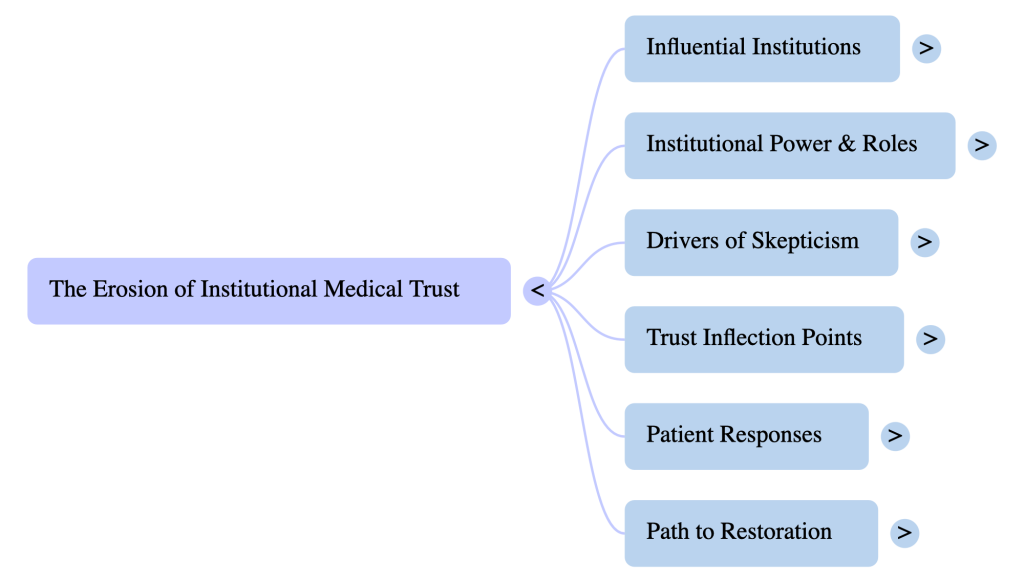
This article is a personal reflection prompted by a recent episode of The World and Everything In It, specifically the Washington Wednesday segment aired on December 24, 2025, which examined medical authority, gender ideology, and the role of major medical institutions in shaping consensus and standards of care. pasted
What stayed with me wasn’t a single policy announcement or political argument. It was a deeper and more troubling question:
Who decides what counts as medical truth—and why are so many Americans losing trust in the institutions that claim to speak for science?
This is not an attack on individual doctors. Many physicians and clinicians are thoughtful, ethical professionals doing their best within a complex system. My concern is not medicine itself, but the institutions that define consensus, enforce professional norms, and determine which questions are considered acceptable to ask.
When Trust Breaks at the Foundation
Trust in medicine depends on clarity, shared definitions, and observable reality. When foundational concepts—such as biological sex—become contested or inconsistently explained by medical authorities, skepticism is not irrational. It is a reasonable response to confusion.
As discussed in Washington Wednesday, many of today’s debates no longer remain confined to clinical journals or exam rooms. They now sit at the intersection of medicine, public policy, psychology, and cultural authority. In those spaces, medical institutions wield enormous influence—and with that influence comes responsibility.
For many people, this discomfort is not driven by religion or politics. It is driven by a sense that basic coherence is being lost, and that disagreement is increasingly treated as moral failure rather than scientific inquiry.
The Power of Medical Gatekeepers
Organizations such as the American Medical Association, American Academy of Pediatrics, American Psychiatric Association, and the Centers for Disease Control and Prevention play an outsized role in American medicine.
They shape:
- standards of care
- professional guidelines
- research priorities
- what is considered “acceptable” medical opinion
- the professional risk associated with dissent
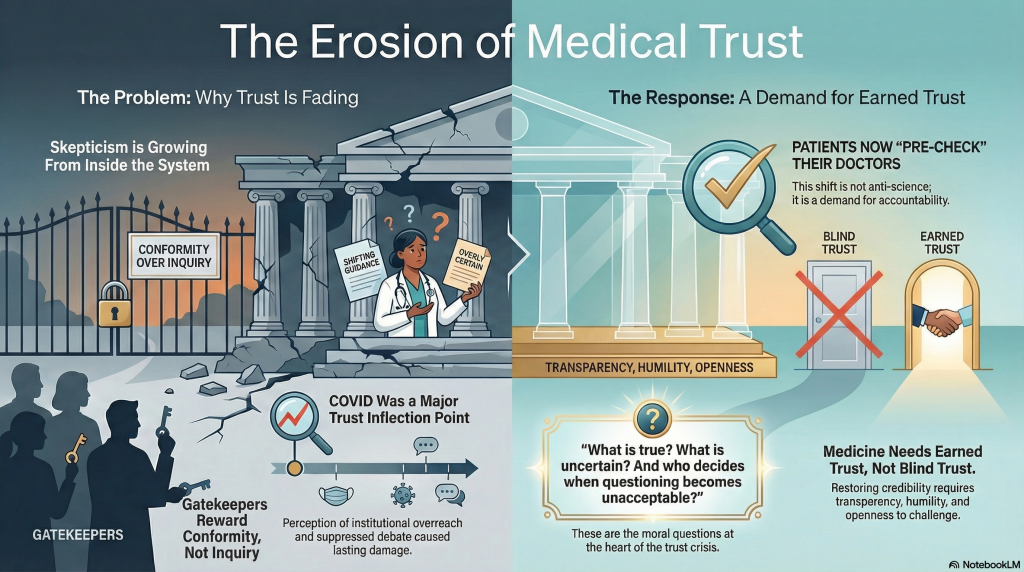
That level of influence is not inherently wrong. But when professional survival depends more on compliance than inquiry, science begins to resemble dogma.
Historically, medical progress has depended on questioning prevailing assumptions. When disagreement becomes professionally dangerous—even when raised in good faith—trust in the system erodes.
A Perspective From Inside Pediatric Medicine
This issue is personal for me.
My wife is a pediatric nurse practitioner. She has spent her career caring for children, following established guidelines, and trusting the institutions that shape pediatric medicine. For many years, CDC guidance served as a professional baseline she relied on and taught to families.
That trust has changed.
Not because of social media, politics, or ideology—but because of what she has observed over time: shifting guidance presented with excessive certainty, limited transparency around tradeoffs, and an increasing sense that institutional positions are shaped as much by external pressure as by open scientific debate.
Her skepticism did not come easily. It came reluctantly, thoughtfully, and from inside the system.
When clinicians who have followed the rules and defended institutional guidance begin quietly saying, “I’m no longer confident these organizations are being fully honest or objective,” that should give all of us pause.
This isn’t about rejecting medicine.
It’s about recognizing when trust has been strained—even among those who once upheld it.
Personal Experience Raises Broader Questions
I have also encountered physicians—including a Harvard-trained oncologist practicing outside the United States—who believe certain lines of inquiry or approaches would be professionally impossible to pursue within the American medical system today.
That does not mean those approaches are correct. But it raises a legitimate question also explored in the podcast:
Does our system reward truth-seeking, or does it reward conformity?
A system that cannot tolerate challenge eventually loses credibility—even among people who want to trust it.
COVID as a Trust Inflection Point
For many Americans, COVID marked a turning point in how medical authority is perceived.
Public health guidance changed rapidly. Messaging often conveyed confidence where uncertainty existed. Debate was discouraged or dismissed. Even where decisions may have been made in good faith, the perception of institutional overreach and ideological alignment caused lasting damage.
As discussed in The World and Everything In It, once trust breaks at that scale, it does not reset easily.
Why People Now “Pre-Check” Doctors
Increasingly, people consult AI tools, independent research, and alternative sources before medical appointments—not to replace physicians, but to avoid blind reliance.
Used responsibly, these tools can:
- surface multiple perspectives
- summarize areas of scientific disagreement
- help patients ask better questions
This shift is not anti-science.
It is pro-accountability.
When institutional credibility weakens, people naturally seek second lenses.
This Is a Moral Question
This is not a religious argument.
It is a moral one:
- What is true?
- What is uncertain?
- And who gets to decide when questioning becomes unacceptable?
Medicine does not need blind trust.
It needs earned trust—through transparency, humility, and openness to challenge.
Until that balance is restored, skepticism will continue to grow.
And that should concern everyone.
Source acknowledgment
This article was inspired by reporting and discussion in Washington Wednesday, The World and Everything In It, December 24, 2025.